


Fumaric Acid
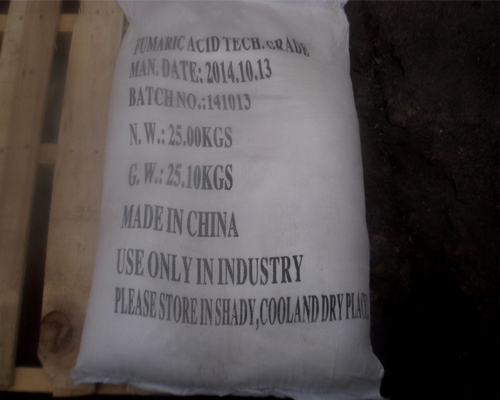
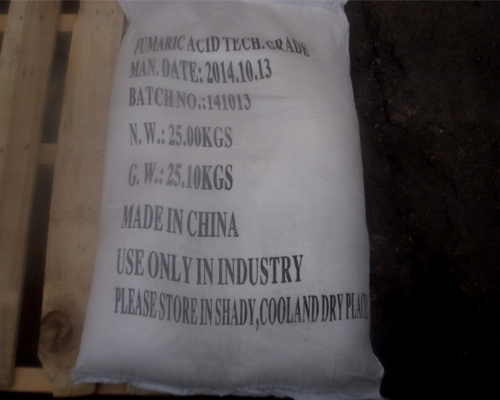
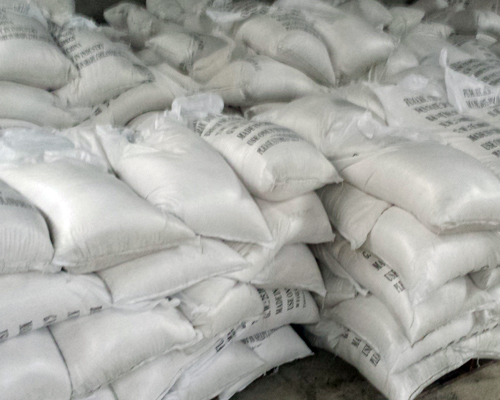

Description
CAS NO.: 110-17-18Molecular Formula: C4H4O4
Molecular Weight: 116.07
Molecular Structural Formula:
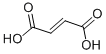
The fumaric acid is also known as trans-butenedioic acid, 2-butenedioic acid, allomaleic acid, lichenic acid, boletic acid. It’s a kind of colorless or white crystals without odor, and it has a fruit-like taste.
The fumaric acid is one of the two isomeric unsaturated dicarboxyl acid, and its salts and esters are known as fumarates. This trans-butenedioic acid is completely soluble in alcohol, partially soluble in water and ether, and hardly soluble in chloroform.
We provide food-grade and industrial-grade fumaric acids for customers worldwide.
Here in TallKee Chemical , we manufacture and supply a wide selection of available in high quality to satisfy different requirements from customers around the world.
Main Applications:
The fumaric acid can find its wide applications in food and beverage industries, pharmaceutic field, resin industry and so on.In food and beverage products, the fumaric acid is currently utilized in wheat and corn tortillas, sour dough and rye breads, refrigerated biscuit doughs, fruit juice and nutraceutical drinks, gelatin deserts, gelling aids, pie fillings and wine, because the fumaric acid can help to improve quality and decreases costs of many food and beverage products. Moreover, it can also find its application in animal feed.
As a food additive, the trans-butenedioic acid has an E number E297 and is used as an acidity regulator. Usually, it is used in beverages and baking powders that have high demands on purity. Also, it is generally used as a substitute for tartaric acid and sometimes in place of citric acid. It can be used as a coagulant in stovetop pudding mixes as well.
In different industries, the fumaric acid can find its applications in unsaturated polyester, alkyd resins, printing inks and paper sizing. It also plays an important role in glass fiber reinforced plastic industry.
Benefits of Fumaric Acid:
1. Long lasting sour taste at pHs less than 4.5: the hydrophobic nature of fumaric acid allows persistent and long-lasting sourness and flavour impact.2. Improving dough machinability: it can blocks or breaks gluten disulphide bonds, which helps to improve dough machinability in wheat flour doughs.
3. Decreasing pH with minimal added sourness: for food and beverage products with a pH bigger than 4.5, it can reduce the pH with minimal added sourness.
4. Anti-microbial effects at low pHs.
5. Greater buffering capacity at pH 3.0.
6. Delayed action leavening acid.
7. Non-hygroscopic.
8. Better flavour stability.
9. Lower ingredient cost.
10. Lower packaging material cost for dry mixes.
Our FUMARIC ACID products are classified into:
1.FUMARIC ACID INDUSTRIAL GRADE2.FUMARIC ACID FOOD GRADE
Typical Properties:
| Description | White, odorless granules or crystalline powder. It is soluble in alcohol, slightly soluble in water and in ether, and very slightly soluble in chloroform | |
| Chemical Name | Trans-butenedioic acid | |
| Molecular Formula | C4H4O4 | |
| Structural Formula |
|
|
| Molecular Weight | 116.07 | |
| Solubility | (g/100g) | |
| in water at 25 | 0.7 | |
| in water at 100 | 9.8 | |
| in alcohol at 30 | 5.76 | |
| in dimethyl benzene at 20 | 0.03 | |
|
Specification (Fcciv,1996) |
Assay(as C4H4O4) | 99.5%~100.5%(anhydrous basis) |
| Melting Point | 294oC~300oC | |
| Arsenic(as As) | 3mg/kg Max | |
| Heavy Metals(as Pb) | 10mg/kg Max | |
| Maleic Acid | 0.10% Max | |
| Residue on Ignition | 0.1% Max | |
| Water | 0.5% Max | |
FUMRAIC ACID FOOD GRADE
| Items | Standards |
| Appearance | White crystalline powder |
| Purity | 99.5% min |
| Melting point | 287 °C min |
| Heavy metals( as Pb) | 10 ppm max |
| Residue on ignition | 0.1% max |
| Arsenic(as As) | 3 ppm max |
| Loss on drying | 0.5% max |
| Maleic Acid | 0.1% max |
FUMARIC ACID TECH GRADE
| Items | Standard Specs. |
| Content % | 99 min |
| Crystallizing point Degree-C min | 52.5max |
| Appearance | White crystal |
| Heavy metal % | 10PPMmax |
| Residue on lgnition % | 0.1% MAX |
| Moisture % | 0.25%max |
| Melting point ℃ | 287-302 |
| Arsenic (as AS)% | 3PPMmax |
| Maleic acid % | 0.1%max |
| Colour degree (HAZEN) | <60 |
Related Products
-
- Benzyl AcetateThe benzyl acetate is widely used in perfumery, cosmetics, and flavorings to impart apple and pear flavors. Moreover, it can also be used as a solvent in plastics and resin, cellulose acetate,
-
- Benzyl BenzoateUsually speaking, the benzyl benzoate is used as an acaricide, scabicide and pediculicide in veterinary hospitals. Also, it serves as repellent for chiggers, ticks and mosquitoes. Moreover, it can be